
Mexico Revisited: 2013-2014
Episode 8: Oaxaca Treats
Jan 25-Feb 1 2014
What a treat! Our suite in the boutique hotel, Casa Cid de Leon, in Oaxaca was the best accommodation we have ever had, anywhere. We lucked out with our RCI timeshare exchange this time. It certainly was a cut above our room in Hostal Santo Domingo in Puebla. We were in “La Belle Epoque”, the biggest suite in the small hotel. Our large sitting room and bedroom are filled with antiques and have three windows, double glazed for sound, looking out onto the street. The bathroom even has a large Jacuzzi that unfortunately doesn’t work, perhaps because of water restrictions. There is a lovely roof top terrace for breakfast but we don’t have a kitchen. This is not a problem as the city has a well deserved reputation for excellent cuisine, so we took advantage of the many restaurants with generally excellent results. Often, after a big breakfast of fruit, eggs and toast, we only have one more meal later in the day. That way we don’t overindulge and gain too much weight. The problem is we could get used to this standard of hotel and not be able to afford our lengthy winter trips. Anyway, we will accept the challenge for a week.
The Zócalo, AKA Plaza de la Constitutión, in front of Cathedral, is less than five minutes from our hotel. Every evening it is full of families enjoying the carnival-like atmosphere, buying balloons for the children and listening to the clown buskers. Several evenings, as well as at noon time, large dance bands played for the enjoyment of couples dressed in their favourite dance outfits. The bands played from 7PM until 8PM after which the families go home and we go for a beer at one of the bars ringing the Zócalo.
Sunday morning started with a marathon right in front of our hotel while we ate breakfast. I don’t know if this was a regular Sunday race or a special occasion but there were a few Africans in the lead group. That evening we heard band music outside on the street outside our window. We rushed to our balcony windows to find a small parade led by young children dressed as angels and men carrying a statue of the child saint of Atocha, popular in Mexico and in the Philippines, followed by a small brass band. Presumably there are enough saints to be honoured every week, if not every day of the year. Later that evening another parade passed in front of our hotel. At the head of the parade were several tall costumed characters on stilts, followed by a brass band.
Another morning many of the streets were jammed with traffic due to police blocking off streets to allow a large crowd of people from small towns surrounding Oaxaca march through the Zócalo and up to our street, Morelos, where they decamped for the rest of the afternoon. They had a large banner demanding clean water, better public transportation, and better administration, all good causes. By supper time they had gone back to their villages to prepare for supper. Finally, Friday morning we heard a brass band playing on our street. Looking out we realized it was a funeral procession. What a procession! The band was the first of a flotilla of white mototaxis, another smaller group of red mototaxis and every dump truck and water truck in the area, honking horns, air and motor brakes. We found out that two rival unions had been vying for contracts to build a new super store. The rivalry turned deadly and a union man and a mototaxi driver had been killed. The parade was bringing both victims to a nearby church for their funeral. The police had to block the road for almost ½ hour to let all the vehicles pass. We were definitely on the parade route.
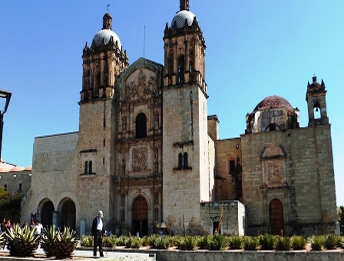
One of the must see tourist attractions in Oaxaca is Santo Domingo de Guzman, a huge church with Mexican baroque interior built in 1611. Most of interior was restored in the 1950s after being damaged during Reform wars in mid 19thC and the Revolution in 1910-21. The Museo de la Cultura de Oaxaca was next to the church in a Dominican convent started in 1572. We remembered touring the museum in 2006 but still spent about 2 hours touring again. The Fray Francisco de Burgoa Library was built in the same style as the Bibliotecha Palafoxiana in Puebla when the convent was converted to a museum to house over 25,000 books from the 15th to the 20th century. It was impressive.
From the balcony of the Museo de la Cultura, we could what looked like a large cactus garden. We found out you could only visit the Ethnobotánico garden as part of a tour and there was an English speaking tour every Tuesday. We were there, right on time, along with about 25 other tourists to follow Carol Turkenik, an expat anthropologist and volunteer docent living in Oaxaca. Carol was very well informed and gave an interesting history of the garden and the plants, which were all endemic to Mexico and mostly from Oaxaca. The church and convent were taken over by the military in mid 19thC and were used as a military station until 1993. A move to turn the property into a convention center and hotel was defeated by the Oaxaqueños. The convent was restored as a museum and the property was developed as a garden open to the public. Half of the garden is devoted to edible plants that need tending and the other half contains plants that can live untended and exiting solely on rains. That means there was a large collection of succulents. It was all amazing and very interesting. We also discovered connections with some of the other visitors. One woman lives in Portland Maine and summers on Cliff Island, next to Peaks Island, where my sisters have summer homes. Marilyn Smith and her husband Luigi who live in Whitehorse. Marilyn is in a book club with Pippa Lawson, who was a member of the OBC, lived next door to my sister Mary in Ottawa and moved with her husband Laurence to Whitehorse. Marilyn also attended UNB in Fredericton NB where she became friends with Nancy Dow, the daughter of Larry, Ray’s favourite teacher in his home town of Florenceville. It’s a small world.
There were a few more churches and museums to visit in Oaxaca, including the Catedral de la Asunción beside the Zócalo. I liked the 17thC Basilica Menor de Nuestra Señora de la Soledad and the smaller Templo de San Felipe Neri where the statue of the Child Saint of Atocha, that was carried in the parade in front of our place, resides. The small Museo Belber Jiménez, housing an eclectic collection of gold Mixtec jewellery, colonial chains and necklaces, 20thC silver by Mexico’s finest, traditional clothing, folk art, pottery and rugs, all the property of jeweler Francisco Jiménez and his wife. Our last visit was to Museo Rufino Tamayo with its large collection of pre-Hispanic artifacts from all over Mexico. There were good explanations giving the significance of most of the pieces, which certainly adds to the enjoyment.
As we did in Puebla, we saved the best restaurant for last. Los Danzantes had been highly recommended and had a special ‘menu del dia’ on Wednesday and Friday. We arrived for lunch on Wednesday only to be told it was by reservation only, so we booked for Friday. Our meal was delicious, starting with a shot glass of tequila, orange pieces dusted with chilli, a good soup and a glass of cooling melon or pineapple fruit juice. The main course was tacos stuffed with shredded meat, a mild salsa and frijoles (refried beans), accompanied by a glass of red or white wine. Dessert was mango custard with skewers of fruit and tea or coffee. It was a great way to end our visit to Oaxaca.
Puerto Morelos Christmas
Playa del Carmen Interlude
Cozumel Wet and Warm
Veracruz, Ancient Trade Route
Enigmatic El Tajin
Chilly Puebla Warmed Our Hearts
Cholula Temples and Churches
Oaxaca Villages
Voyage to Puerto Angel
Puerto Escondido of Many Beaches
Acapulco, a Faded Bloom
Zihuatanejo, the Seducer
Manzanillo, Playa Azul
Mellow Melaque
Bucerias, Our Last Beach
Musical Guadalajara
UNESCO Zacatecas
San Miguel de Allende, a Perfect Ending