
Mexico Revisited: 2013-2014
Episode 7: Cholula Temples and Churches
January 23 2014
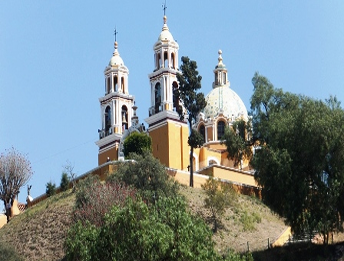
The first Spanish reports back from their visit in 1519 to Cholula, just 15 km west of present day Puebla, were misinterpreted. Instead of almost 400 towers, the words were interpreted to mean 365 temples. Cortés spent his time in Cholula killing most of the inhabitant, destroying temples and replacing them with churches. There are now 39 churches in Cholula which is still a huge number for the area. The biggest church, Nuestra Señora de los Remedios, was built on a forested hilltop in 1574-5, which unknown to the Spaniards, was really a pyramid. Pirámide Tepanapa AKA Tlachihualtepetl AKA the Great Pyramid of Cholula is now a UNESCO World Heritage site. It is one of the largest pyramids in the world, at 55 meters tall with a base that measures over 396 meters on each side. One theory is that Tepanapa was covered by a volcanic eruption which caused the temple to be abandoned, although people still lived in the area. In fact, Cholula is the longest occupied city in Mexico.
We had a day tour to visit Tepanapa and two churches. This was our second visit to Cholula and this time we toured with an informative local guide, which made a big difference. Tepanapa is actually 6 flat topped temples built one on top of the other every 52 years between 200BC and 800AD and is dedicated to the deity Quetzalcoatl. The architecture is similar to the temples we have visited in El Tajín and Teotihuacan. Rather than try to uncover the temple, archaeologists constructed 8 km of tunnels in 1931 underneath in order to map and model the interior structure. Only about 88M of the tunnels are open to the public. We walked along arched passage ways which were just high enough for a six-footer to walk without stooping and wide enough to accommodate narrow rail tracks which were ued to carry our debris when the tunnels were built. Along the way we could see stepped tunnels leading to upper and lower levels. It was quite a fascinating operation to see.
Outside the temple is the huge Patio de los Altares, named for its seven altars, used for religious ceremonies, including some that involved human sacrifice. During the colonial period, the pyramid was severely damaged on its north side in order to build the Camino Real to Puebla and a later hospital, now abandoned. The west was damaged later with the installation of a rail line.
Nuestra Señora de los Remedios, on top of Tepanapa, is a major pilgrimage site. Its altar is laminated with 24-carat gold leaf and the walls are decorated in Mexican Baroque style. That means they covered with cherubs, angels and saints in the bright colours Mexicans like. The church was struck and damaged by lightning several times, which the idigenous attributed to the old goddess getting even for destroying the original temple.
Before setting off to see our second church, we stopped at a shop selling Mezcal, similar to Tequila, for a tasting. It was tasty enough, but not enough to buy a bottle.
I thought Nuestra Señora de los Remedios was ornate until we visited Sta Maria Tonantzintla, the Place of Our Lady Mother, 8 km away from Cholula. The front entrance was clad in pink and blue tiles and the interior was beyond belief baroque, mixing the pre-Hispanic world with the Spanish Christian world. The walls were encrusted in images sporting feathers, fruits and flowers and other decorations from the floor to the ceiling. It was too much to take in one sitting.
Puerto Morelos Christmas
Playa del Carmen Interlude
Cozumel Wet and Warm
Veracruz, Ancient Trade Route
Enigmatic El Tajin
Chilly Puebla Warmed Our Hearts
Oaxaca Treats
Oaxaca Villages
Voyage to Puerto Angel
Puerto Escondido of Many Beaches
Acapulco, a Faded Bloom
Zihuatanejo, the Seducer
Manzanillo, Playa Azul
Mellow Melaque
Bucerias, Our Last Beach
Musical Guadalajara
UNESCO Zacatecas
San Miguel de Allende, a Perfect Ending